Claude Code + CodexSkill v0.2.0MIT licensedLinux & macOS
lanes
The right model for every task. The same gates for every change.
A multi-model orchestration skill for parallel software work. The orchestrator plans, dispatches and integrates; each worker receives a short, complete task in its own Git worktree, and an independent reviewer checks every completed lane. The main worktree handles orchestration, planning and integration.
01 How it works
One orchestrator. Many lanes. The same gates.
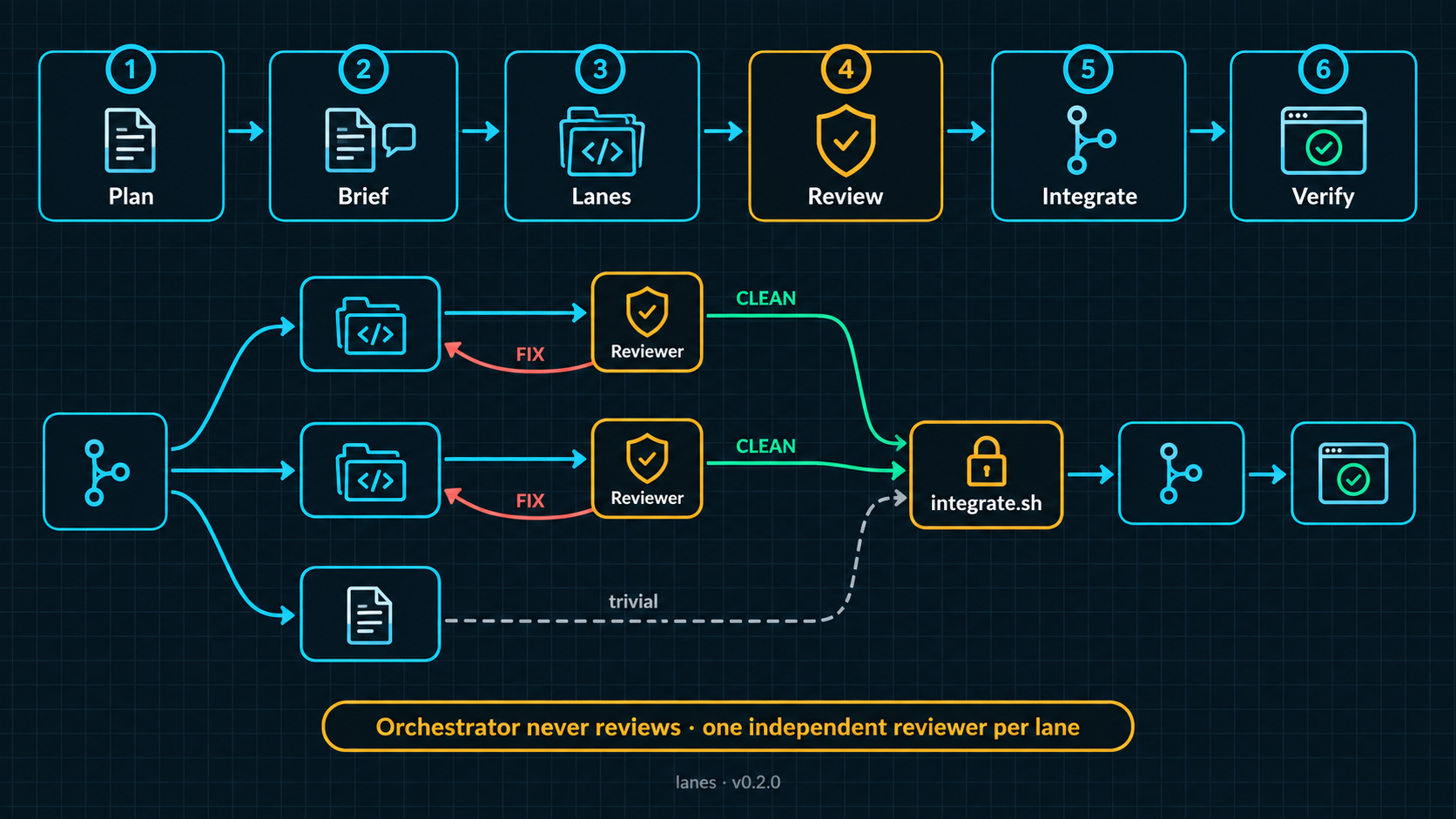
The orchestrator plans, dispatches, acts on review verdicts and integrates; it never reviews lane work itself. Workers implement only in assigned worktrees and return compact evidence. The main worktree handles orchestration, planning and integration.
Lanes are worktrees
Each lane is a git worktree with one agent in it. Lanes run in parallel, up to a cap you choose (default 6 concurrent agents, reviews included).
Route by task
Sol at medium effort handles routine coordination. Opus 5.5 defaults to medium in Claude Code. Use high effort for legal meaning, security, difficult defects and final acceptance; use Luna or scripts for structural checks.
Gates don't change
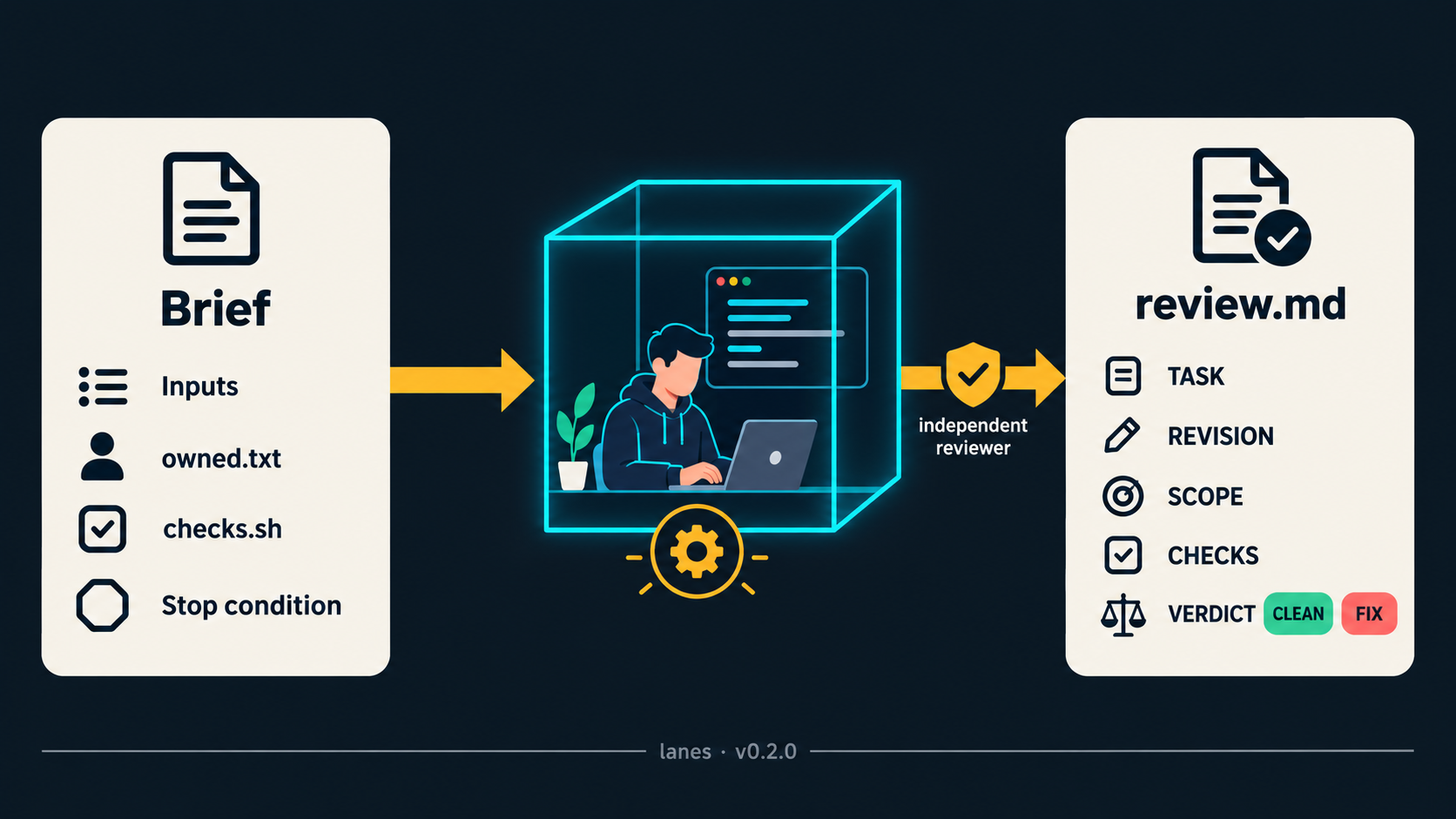
Each completion event goes to an independent reviewer, never the author or the orchestrator. It runs a deterministic scope check (hashes, out-of-scope paths, uncommitted work) and returns CLEAN or FIX for the exact revision.
Per-task flow
- Brief the task with inputs, owned files, acceptance checks, limits and a stop condition.
- Implement in an assigned worktree and signal completion with the exit status.
- Run one reconciliation check for file hashes, check totals and unchanged files.
- Review independently. The author never reviews its own work.
- Integrate accepted changes in the main worktree, then update the tracker with evidence.
- Record usage and acceptance before closing the task.
Why the relay design (T1 lanes)
A Claude Code subagent file can't point at another provider: it has no baseUrl field, and model only takes Claude models.
So each external model (DeepSeek, GLM) runs as a separate headless Claude Code process pointed at that provider's Anthropic-compatible API (claude-via <provider>). A small guarded relay subagent hands tasks to it.
A PreToolUse hook (relay-guard) blocks every command except the relay itself; without it, the small relay model does the task itself instead of delegating.
Every run leaves a job record with the model that actually did the work.
v0.2.0 Release notes
Independent review. Enforced merges.
The orchestrator no longer reviews its own lanes, and unreviewed work can no longer reach the main branch.
A reviewer per lane
Every completed lane goes to an independent reviewer:
lane-reviewer(Opus 5.5, medium) in Claude Code orgpt-5.6-terra(medium) in Codex. FIX findings go back to the same lane.Gated in code
lane/integrate.shis the only merge path. It requires a CLEAN verdict for the exact lane head; small prose edits it classifies as trivial skip review.Hardened relays
External models refuse the main checkout and
.envfiles, the relay guard blocks command smuggling, relays run on macOS, and pushes require a clean secret scan.
02 Routing
Triage first. The tier picks the model.
Use Sol at medium effort for routine coordination and Opus 5.5 at medium effort as the Claude Code default. Raise effort for legal meaning, security, difficult defects and final acceptance. Use Luna or scripts for structural checks, and reserve DeepSeek and GLM for simple tasks.
| Tier / role | Lane | Billed to |
|---|---|---|
| High effortLegal meaning, security, difficult defects, or final acceptance | Codex Sol or Claude Opus 5.5 | your ChatGPT or Claude plan |
| T2 ModerateClear spec, but multi-file or needs design judgment | Codex Sol by default; sonnet-lane for delegated Claude coding |
your ChatGPT or Claude plan |
| Simple tasksWell-specified, self-contained implementation with clear checks | DeepSeek or GLM 5.3 Flash for bounded work | your DeepSeek / OpenRouter API keys |
| Structural checksCounts, hashes, format and unchanged-file checks | Codex Luna or a deterministic script | your ChatGPT plan |
| Lane reviewEvery completed lane, and each fix round | Claude Opus 5.5 (lane-reviewer) or Codex Terra (gpt-5.6-terra), medium effort |
your Claude or ChatGPT plan |
| OrchestrationPlan, dispatch, report and integration | Codex Sol or Claude Opus 5.5, medium effort by default | your ChatGPT or Claude plan |
Recommended orchestration defaults are Codex Sol at medium effort and Claude Opus 5.5 at medium effort. Use high effort only for legal meaning, security, difficult defects and final acceptance. Each task brief states a token cap; short drafts stop at 500 output tokens. Record input, cached input, output, failures and acceptance in the lane usage ledger. Completion events trigger an independent review instead of repeated status scans. Model overrides: DEEPSEEK_MODEL, GLM_MODEL, CODEX_MODEL, CODEX_EFFORT.
- Review before mergeEvery lane gets an independent reviewer, never the orchestrator. FIX findings go back to the same lane.
lane/integrate.shis the only merge path and refuses anything without a CLEAN verdict for the current revision; only small prose edits it classifies as trivial skip review. - Workers stay in worktrees
model-relayrefuses the main checkout and any worktree holding.envfiles. - Either host reviews.Claude Code uses
lane-reviewer; Codex usescodex-review.
03 Install
Clone it into your skills folder.
The installer checks prerequisites and both keys, tells you exactly what to add if something is missing, and backs up any file it replaces.
git clone https://github.com/thebpandey/lanes ~/.claude/skills/lanes
bash ~/.claude/skills/lanes/install.sh            # installs relays, configs, and the opus-lane/sonnet-lane/lane-reviewer/deepseek/glm/codex subagents
bash ~/.claude/skills/lanes/install.sh --smoke    # optional: one tiny task through each provider
bash ~/.claude/skills/lanes/install.sh --watchdog # optional (Linux): timer that cleans orphaned agent work
Then restart Claude Codeso the opus-lane, sonnet-lane, lane-reviewer, deepseek, glm and codex subagents load. Until then, the direct commands work without a restart.
What it installs
- In
~/.local/bin:claude-via,claude-deepseek,claude-glm,model-relay,relay-guard,relay-spawnandcodex-review. ~/.claude/{deepseek,glm}.json, which hold the base URL, the model and the name of the key variable.~/.claude/agents/{opus-lane,sonnet-lane}.md: Opus lane at medium effort by default, with high for legal meaning, security, difficult defects and final acceptance; Sonnet handles delegated moderate coding.lane-reviewer.mdis the independent Opus 5.5 reviewer (medium effort, read-only) for every completed lane. The other agents are guarded relays.
Requirements
- RequiredClaude Code,
git,python3,curlandbashon Linux or macOS. The watchdog timer is Linux/systemd only. - Key
DEEPSEEK_API_KEY: create one at platform.deepseek.com. - Key
OPENROUTER_API_KEY: create one at openrouter.ai/keys. Set a spend limit, and under Privacy block providers that train on prompts. - OptionalThe Codex CLI (
npm i -g @openai/codex, thencodex login) for Codex-hosted lane reviews. Claude Code reviews use thelane-revieweragent. - OptionalDocker, for disposable test databases. Beads (
bd) for issue tracking.
Export keys in your shell rc. Never paste a key into the chat; the skill never writes one anywhere.
04 Use
Say it in any git project.
Start Claude Code in the project and talk to the orchestrator. Status updates focus on completion events and changed lane states.
- /lanes start
Audits the project (instructions, git history, worktrees, tracker), shows what's done, in progress, ready and blocked, triages each task into a tier, asks a few setup questions one at a time, then runs the lanes.
- lane update
Blockers, completed events and changed lane states in a compact 10–12-line summary.
- lane update all
A concise view of every workstream task and its current state.
- pause lanes · resume the lanes
Safe pause notes per lane, and resuming into the same worktrees.
Direct commands no Claude tokens
Run from the shell. Model overrides: DEEPSEEK_MODEL, GLM_MODEL, CODEX_MODEL; set CODEX_EFFORT=high for high-risk review. To add another Anthropic-compatible provider, drop a ~/.claude/<name>.json next to the others.
cd <worktree> && RELAY_WAIT_S=6000 model-relay deepseek < brief.md   # or: model-relay glm
cd <worktree> && RELAY_WAIT_S=6000 codex-review main owned.txt < checklist.md
~/.claude/skills/lanes/lane/new-worktree.sh <branch>                  # worktree + monorepo node_modules wiring
~/.claude/skills/lanes/lane/lane-status.sh                            # evidence table for "lane update"
05 Safety notes
Read these before the first run.
Data leaves your machine
DeepSeek and GLM receive whatever the task gives them, and run with full shell access inside their worktree, with
.envreads denied. Run them only in worktrees, and never give them secrets, credentials or customer data.Costs
total_cost_usdin a worker's output is priced as if the run were Claude, so ignore it. Check your real spend on the DeepSeek balance page and onhttps://openrouter.ai/api/v1/key.Self-identification
Workers call themselves "Claude" because Claude Code's system prompt says so. The job record's
model:line shows the real model.Approvals
The skill asks before pushes, deploys, external writes, and anything hard to undo.
06 Uninstall
Three lines to remove it all.
rm -f ~/.local/bin/{claude-via,claude-deepseek,claude-glm,model-relay,relay-guard,relay-spawn,codex-review}
rm -f ~/.claude/{deepseek,glm}.json ~/.claude/agents/{deepseek,glm,codex,opus-lane,sonnet-lane,lane-reviewer}.md
systemctl --user disable --now lanes-watchdog.timer 2>/dev/null; rm -rf ~/.claude/skills/lanes